

 This article appears in the Fall 2026 issue

The Covered Bridges of the
Ashuelot River
Story and photos by John Burk

Ashuelot Covered Bridge features an Ithiel Town truss design. Ashuelot is a village in Winchester, NH.
In the Ashuelot River Valley of southwestern New Hampshire, six historic covered bridges stand as examples of 19th-century engineering, innovation, and craftsmanship. Treasured as historic landmarks today, when built they served as important links between rural communities, connected farms and factories to markets, and facilitated development of modern transportation networks.
A driving tour of the Ashuelot River bridges makes for a classic New England day trip, especially during fall foliage season. Passing through the towns of Winchester and Swanzey, the 17-mile route showcases a variety of historical and natural features on the Ashuelot River, the Connecticut River’s largest tributary in New Hampshire. Side roads to the bridges are clearly marked with brown signs. A rail trail offers the option of touring by bicycle or on foot.
Among 13,000 covered bridges built in the US, hundreds of covered bridges were erected throughout the Connecticut River watershed during the 19th century. The first, completed in 1818, was a massive 975-foot toll bridge at Hartford, Connecticut. Nearly 80 eventually crossed the Connecticut River.
Covered bridges lasted much longer than unprotected wooden spans exposed to rain, snow, and ice. By the mid-20th century, though, many had been washed away by floods, replaced with steel and concrete spans, or lost to fire and neglect. Fortunately, since the 1950s many communities, organizations, and preservationists have worked to save and rehabilitate the remaining structures of the approximately 850 still extant across the US.
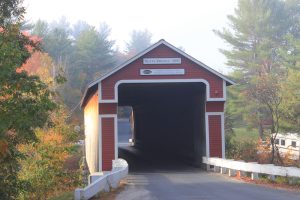
Slate Bridge in Westport, a village of Swanzey, NH.
On a misty morning last fall, I followed Route 119 to the Ashuelot Bridge in Ashuelot, a village in the western portion of Winchester. (From either I-91 north or south, set your GPS for Hinsdale where you can pick up Route 119 East.) With its distinctive white paint and red roof, exposed lattice truss, and pedestrian walkways, the photogenic structure is one of New England’s best-known covered bridges.
The bridge was built in 1864 to connect the village to the Ashuelot Railroad, a 23-mile line that extended from Hinsdale to Keene. Established in 1851 and acquired by the Boston and Maine Railroad in 1893, the railroad prompted industrial development and growth in the valley during the late 19th century. After the railroad ended service in 1983, the Ashuelot Recreational Rail Trail was established on the abandoned corridor.
The Ashuelot Bridge utilizes Ithiel Town’s truss system comprised of crisscrossed narrow beams. Town, an architect from Connecticut who built the first three covered bridges over the Connecticut River, patented the design in 1820. Renown for strength, durability, and ease of assembly, the Town truss was popular throughout New England.
From Winchester’s historic town center, proceed north on Route 10 to the Coombs Bridge, located on a side road. Although many sources list 1837 as the year of its construction, town records indicate the structure was built in 1843. The bridge was reconstructed in 1997 by a company owned by Stan Graton II, who continues a family tradition that dates back to the 1950s. His grandfather, Milton, and father, Arnold, were nationally recognized bridgewrights and pioneers of covered bridge restoration.
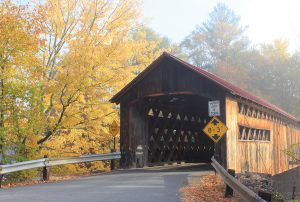
Combs Covered Bridge, Winchester, NH.
Nearby in Westport (a village of Swanzey), the Slate Bridge occupies a crossing with a history of mishaps. The first covered bridge at the site was built in 1862 to replace a span that collapsed when a local farmer crossed it with his oxen. In 1917 an elderly man suffered a gunshot wound while fleeing from an attempted armed robbery on the bridge.
In March 1993 the bridge burned in a suspicious early morning fire. Flames rapidly engulfed the structure. Two other covered bridges in New Hampshire were destroyed by arson in 1993, part of an unfortunate trend that occurred throughout the country during the late-20th century. Thanks to the dedicated efforts of a fundraising committee, the Slate Bridge was reconstructed in 2001 at a cost of $950,000. The new bridge largely replicates the original design while incorporating safety measures such as fire detection and protection systems.
Continue north on Route 10 to West Swanzey, where a short detour on California Street leads to the Thompson Bridge at a crossing next to a former textile mill and a town park. Built in 1832, the structure is one of New Hampshire’s oldest covered bridges. It was named in honor of West Swanzey resident Henry Denman Thompson, a prominent 19th-century vaudeville actor and playwright. In 1930 Henry Ford tried to buy the bridge for the Greenfield Village Museum in Michigan. After the town declined the offer, Ford acquired a bridge in Pennsylvania.
The mill complex was established during the mid-19th century, a time of rapid industrial development in the Ashuelot Valley. A crib dam near the Thompson Bridge provided power for the mill, which housed the Homestead Woolen Company from 1911 to 1985. In 2010 the dam was removed as part of an initiative to restore the river’s natural flow and enhance habitats for migratory fish, dwarf wedge mussels, and other aquatic species.
Just north of West Swanzey, turn right on Sawyer’s Crossing Road to make your way east to Cresson Bridge. Built in 1859, it spans the Ashuelot River at a location historically known as Sand Bank for its extensive glacial deposits of sand and gravel. In precolonial times, a large Native American settlement with a stone fishing dam existed near the site.
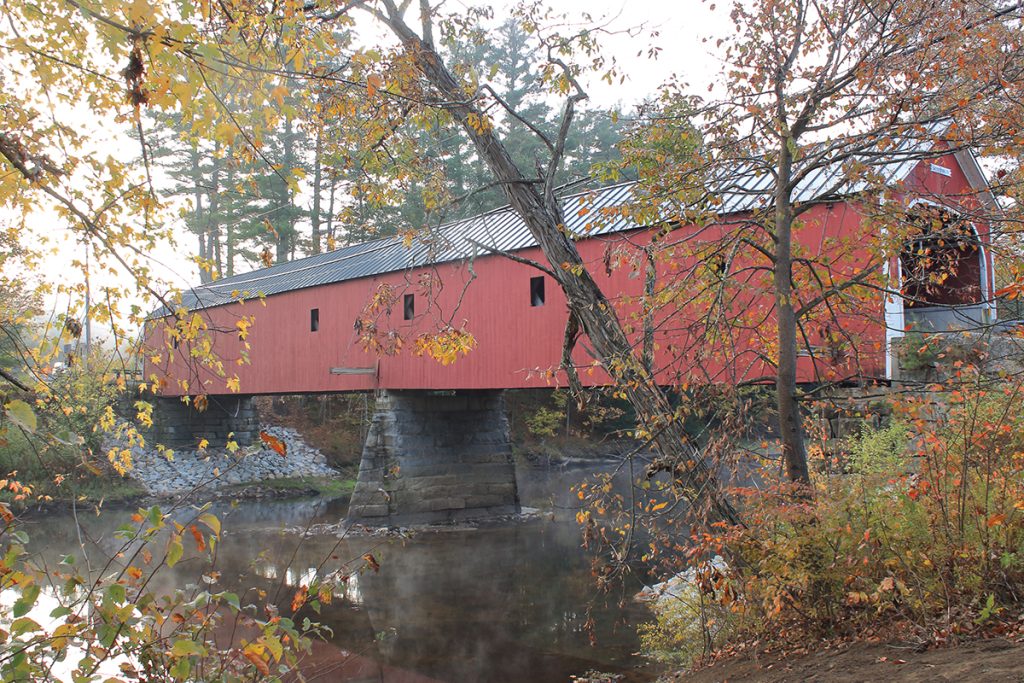
Cresson Bridge, Swanzey, NH
In 1953 the Cresson Bridge gained national fame when the noted broadcaster and entertainer Arthur Godfrey featured it on his television show as part of a commercial for a cigarette company. New Hampshire governor Hugh Gregg presented Godfrey with an honorary deed to the structure. Located on a travel route between Swanzey and Keene, the Cresson Bridge supports a higher volume of traffic than the region’s other covered bridges. It was rehabilitated in 1996 with a new floor, roof, and truss components.
Head south to Swanzey Center and complete your tour by following Route 32 south to the Carlton Bridge on Carlton Road. The diminutive 67-foot structure crosses the South Branch of the Ashuelot River, a tributary that joins the main stem near the Cresson Bridge. Originally assembled in 1869 by local barn builders, this bridge is distinguished by its rare Queenspost truss, a historic design that was often utilized in barns and churches. The portals were reputedly shaped to accommodate wagons loaded with hay. After deterioration caused closure of the structure in 1974, it was rebuilt in 1996.
John Burk is a writer, photographer, and historian from western Massachusetts whose credits include books, guides, and articles in nature and regional publications.
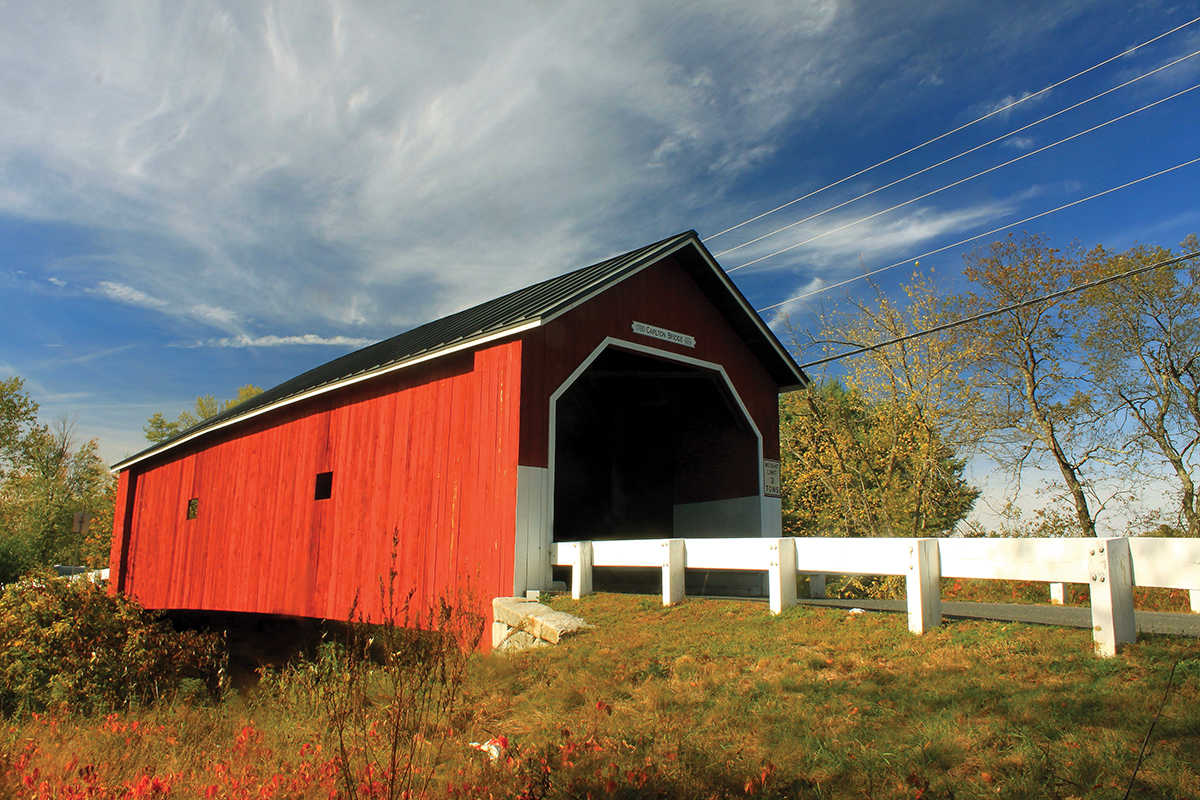
Carleton Bridge, Swanzey, NH.
The Ashuelot Recreational Rail Trail
The Ashuelot Recreational Rail Trail offers options to explore the bridges by bike or on foot. Roughly 3.5 miles east of the center of Hinsdale, the trail passes by the Ashuelot Bridge and a former depot (now privately owned). Continuing north, the Coombs Bridge lies 0.2 miles west of the crossing at Coombs Bridge Road. In Westport, a 0.7-mile detour on Holbrook Avenue and Westbrook Village Road leads to the Slate Bridge. At West Swanzey, the Thompson Bridge is 0.3 miles west of the intersection with Railroad Street. After crossing a historic trestle bridge, the trail reaches Sawyer’s Crossing Road 500 feet west of the Cresson Bridge, where parking is available. The distance between the Ashuelot and Cresson bridges is 15.5 miles one-way.
Getting There
From Interstate 91 in Brattleboro, take Exit 1 and follow US 5 north 1.2 miles. Turn right on Vernon Street, then take the next left on NH 119. Cross the Brattleboro-Hinsdale Bridge over the Connecticut River and continue 10.2 miles to the Ashuelot Covered Bridge. At the route’s northern end, from the intersection of NH 32 and NH 12 in Keene, follow NH 32 south 4.7 miles to the Carlton Bridge.
For More About the Bridges
Covered Spans of Yesteryear, lostbridges.org
Town of Swanzey, swanzeynh.gov/community/covered_bridge_infomation.php