

 This article appears in the Fall 2026 issue
 A Trout Stream for Sale
Story and Photos by Ed Mitchell
In my columns, I have taken you fly-fishing the length of the wonderful Connecticut River—from the headwaters in the Great North Woods of New Hampshire to the Green Mountains of Vermont, the Berkshires of Massachusetts, and the many waters of Connecticut. Truthfully, it has been my pleasure, and many fine destinations lie ahead. Yet it is fair to say we have already covered a diversity of waters, large and small.

A mythical trout stream for sale, inspired by a chapter in Richard Brautigan’s 1967 novella, Trout Fishing in America.
Today we head to a trout stream without a name, nor found on any map. Yet it is claimed to run cool, clear, and to host fine fishing. Best of all, it is up for sale. You can purchase the whole stream, or as little as you want. And it is priced reasonably. This will be a fun adventure that offers us a chance to discuss trout stream habitat. So, grab your wallet and come along.
To attend the sale, we’ll travel back in time to 1967 when Trout Fishing in America appeared. Written by Richard Brautigan, poet, novelist, and cosmic thinker, today it is deemed a cult classic. Surprisingly it contains no actual angling. Fear not, however, the author has solid fly-fishing credentials, having spent years fishing the fabled waters of Montana and Key West with legendary friends artist/writer Russ Chatham, songwriter Jimmy Buffet, and novelists Jim Harrison and Thomas McGuane.
The book contains a chapter titled “The Cleveland Wrecking Yard.” Here Brautigan playfully tells us about a salvage company where a large sign proclaims, “Used Trout Stream For Sale, Must Be Seen To Be Appreciated.” This is hilarious fiction, of course, but for the moment, let’s envision ourselves accompanying Brautigan as he visits the yard seeking to own his own trout stream.
Upon arrival, a salesman informs Brautigan that the stream was carefully shipped to the yard from Colorado and is available in varying lengths at a fair cost of $5 a foot, assuming you buy at least 100 feet. The various river sections, including riffles, bends, and pools, are laying about in the yard. Brautigan learns there are a few waterfalls, too. They are more expensive and located upstairs in the used plumbing department. The cost? Nineteen dollars a foot.
After perusing the river sections, Brautigan begins negotiating. Are trout available? Do the riverbanks have healthy foliage? Is there any wildlife? The salesman replies to each question. All sections come with trout aboard, although the exact number and size is unknown. The author peers into the stream and sees trout, including a good one. He is satisfied. Yes, sections come with a riparian buffer of ample trees, brushes, grass, flowers, and ferns. Good news. The salesman also reports birds are available at 35 cents each, although, the author is warned they are secondhand and come with no guarantee. There are only three deer left for sale, however, but there are aquatic insects for the trout to eat.
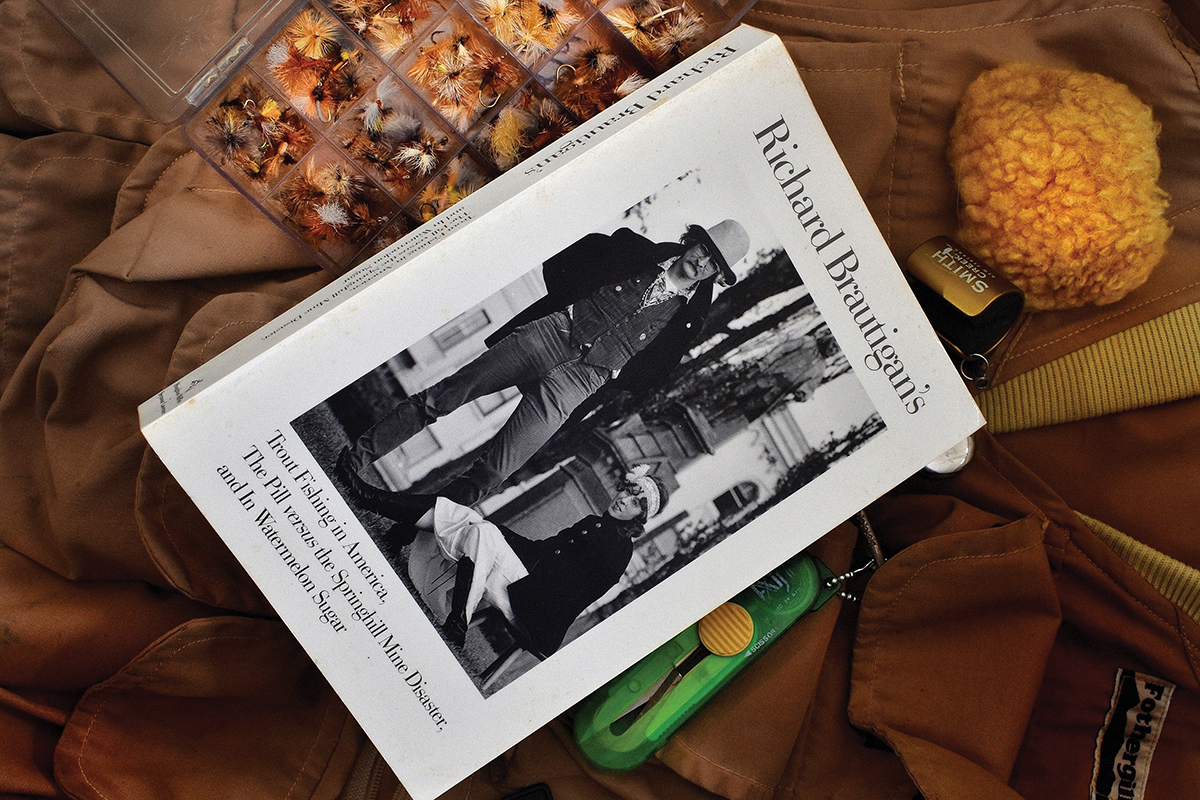
Richard Brautigan’s novella, Trout Fishing in America, 1967.
We never learn if Brautigan closes the deal. Purchasing the stream is left to readers, and a central question lies before us: Which sections of the river should we buy to create a vital trout stream? The answer is found in the word “habitat.” It derives from the Latin verb habitare, loosely translated as “a place to reside.” And it is only in a proper place that wildlife survives. Each of the various river sections offers a different habitat where trout can prosper. And when we join the habitats together to make a stream, we improve trout’s chances of survival, permitting them to move around as needed to feed, find shelter, and adjust to the seasons.
Let’s buy a few pools and riffles. Granted, they are totally dissimilar waters, yet both are indispensable. Riffles are shallow, current-laden waters, with a hard substrate, making an ideal residence for mayflies, caddis, stonefly nymphs, and midges to grow. These aquatic insects are essential forage; trout love them all. And this is where the finest dry fly-fishing is apt to occur. By late April, the stately Hendrickson duns (Ephemerella subvaria) appear, riding the midday currents. And shortly the March browns (Stenonema vicarium) follow. Then on June evenings, dainty sulphurs (Nathalis iole) grace the water. By warm August dawns, you’ll be struggling to tie on size 22 dry, as tiny tricos (Tricorythodes) hang in clouds over the stream. Fear not, however, there is one large mayfly left in the season, the mahogany dun (Isonychia bicolor). These huge mayflies can catch you by surprise. They don’t emerge midstream, instead preferring to hug the currents along the bank. Be careful or you will miss them. And return in autumn on dreary days. The blue-winged olives (Baetis) may visit you.
Pools provide a counterbalance of deeper, slow-moving water, often with a softer bottom. When trout are done feeding in riffles, they often drop back to pools for safety. They are less vulnerable to predation by blue herons and osprey there. And a pool’s depth offers a cool place for trout to hang out in the heat of summer. Or ride out a flood. Slower waters offer residence to older, larger trout, who dislike constantly fighting fast currents. Yes, fewer mayflies live in pools, but there is still dry fly fishing. The mayfly duns that hatch upstream in the riffles typically drift down current into the head of a pool, producing excellent fishing. And the few mayfly nymphs that live in the soft bottom produce the biggest duns you’ll ever see, including the drake green (Ephemera guttulate), the brown drake (Ephemera simulans), and the golden drake (Anthopotamus distinctus).
Is our money holding out? Then here are two more habitats I recommend we purchase: a river bend and a waterfall. River bends are dynamic, containing both slow and fast water, and can be shallow or deep. The current on the outer bend carves under the bank. Good-size trout reside here tucked out of the sun. Drift a pheasant tail nymph as tight to the shore as you can. Come summer this is an ideal place to cast a terrestrial dry fly. I advise a hopper or a beetle. Fish the central currents too. They are a great spot to cast a team of wet flies or a soft hackle. Expect the strike to come as your flies swing toward the shore. The inside of the bend is slow and shallow, allowing you to wade out to cast. And in the right light you may be able to sight-fish here for cruising trout.
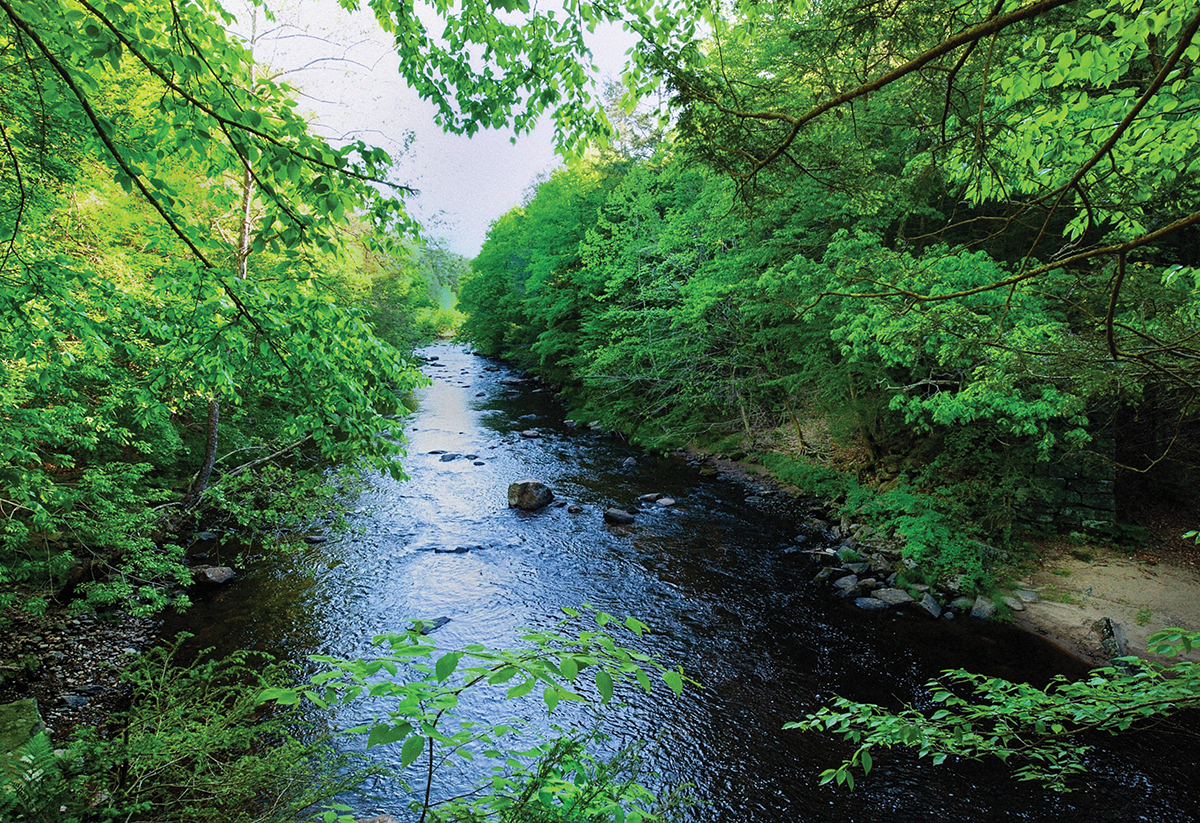
A riparian buffer makes for a healthy trout habitat.
Waterfalls seem extravagant, but let’s get one. They oxygenate the waters, and immediately below is a deep pool with a rocky bottom, home to large forage such as sculpins, crayfish, and hellgramites. In addition, monster trout lurk here, lingering in the cool, shadowy depths. Granted these big boys are typically active only at night. Yet they often drop downstream to feed at the tail of the pool in low light. Try swinging a streamer there at dusk or dawn. Hang on tight.
Together we have made a fine little trout stream, one I’m sure Brautigan would have loved. And hopefully we’ve done it without breaking the bank.
Ed Mitchell is the author of four books on fly-fishing and has written for many magazines. He has over 50 years of experience in both fresh and saltwater fly-fishing. He tips his hat to the late Richard Brautigan who, with childlike ease, seamlessly wove reality and dreams.