
Island Solitude
 “Come to the woods, for here there is rest,” wrote John Muir, the pioneering environmental activist and writer. “There is no repose like that of the green deep woods.” Few knew the healing power of nature better than Muir (1838–1914), whose deep connection with the outdoors was forged through a convalescence. It was in March of 1867 that the Sottish-born Muir was working in a wagon wheel factory in Indianapolis when he suffered a serious eye injury. Confined to a darkened room for six weeks in order to regain his sight, the 28-year-old Muir, who had studied botany in college but never graduated, was forced to reflect on his life and his purpose. It was during this period of solitude, Muir says, that he determined “to be true to himself” and follow his dream of studying plants, immersing himself in nature and the outdoors. “This affliction has driven me to the sweet fields,” Muir later wrote. “God has to nearly kill us sometimes, to teach us lessons.”
Today, many of us find ourselves confined to our “darkened rooms,” or perhaps more precisely, as in Dante’s Inferno, trapped “in a dark wood, where the direct way [is] lost.” Dante goes on to tell us: “It is a hard thing to speak of, how wild, harsh and impenetrable that wood was, so that thinking of it recreates the fear.” His words speak to us over the centuries. Dante had Virgil to lead him out of the gloom. Who will be our guide?
When I really need to escape, I paddle my canoe over to an island in the lower Connecticut River—a rocky, wooded, wild place with a meandering creek and marshes on the back side. The day I visited, I beached my craft near the inlet on the northern end, following a trail into the woods up to the crest of a ridge, a couple of hundred feet above the river. Seated on a rock in a clearing, I looked down through the dark trees to the glittering water. It was late afternoon, when the sounds of the powerboats fade away and a deep solitude washes over the place. The stillness was a tonic.
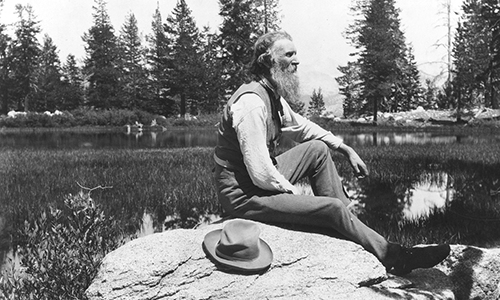
John Muir, ca. 1902
Image Credit: Library of Congress
In that ethereal quiet it was hard to image that in the 19th century this island swarmed with 600 men, mainly Irish and Italian immigrants, who lived in camps from May to October to work the granite quarries. It was an extensive operation, with steam drills and derricks and a narrow gauge railroad to haul the massive blocks to waiting schooners. This island in the Connecticut River was known for its usually dense gneiss, prized in New York City and Philadelphia for street paving and curbing.
Quarrying ended abruptly in 1902, when the stone business was no longer profitable. The woods grew back, and the island became a haven for those who wanted to escape, for whatever reason. In the 1930s, a reputed gangster hid out on the island to evade capture. He built a lean-to against some rocks and camouflaged it with branches. Friends brought him food and supplies. The authorities never found him.
The island’s best-known hermit was a fellow by the name of Andrew Holloway. Jilted by his wife who favored his brother, Holloway vowed never to speak to another human being. He built a houseboat and paddled it to the island, where he lived as a recluse for 50 years. When friends came to visit, he communicated by writing on a slate.
A beautiful, wild, lonely place, this island.
–Erik Hesselberg, Managing Editor
My Connecticut River, cont...
We weren’t settled for very long in Glastonbury before I joined the Connecticut Audubon Society and became a member of the Regional Board of Directors of its nature center in Glastonbury and then was elected to the state Board of Directors. These responsibilities introduced me to still more dimensions of the Connecticut River. Volunteering at the Eagle Festival, which the Society used to host as a major fundraiser toward the end of winter each year, brought me in contact with the charming village of Essex, which I quickly grew to adore—a liking born of the scenic bicycle ride along the Connecticut on River Road, the breathtaking view to the east across the River, the Connecticut River Museum, and the choice of very good restaurants in town.
I fondly recall one festival day when the temperature didn’t rise above 0° F. We froze on the ferry that was plying the river in search of eagles; despite the cold, we spotted 17 bald eagles and one golden eagle. Afterward, we warmed up at the Griswold Inn with a steaming bowl of their gourmet New England clam chowder while seated beside a crackling fire in the Inn’s colonial-era fireplace.
Another allure of Essex is the steam train that chuffs and whistles along the River pulling restored Pullman cars and, as an option, off-loads passengers for a 2-hour boat ride on the Becky Thatcher up and down the River. We’ve also taken our grandkids on the train ride option that drops passengers off at the road (Route 148, Ferry Road) to the Chester-Hadlyme Ferry and gives travelers enough time to cross the river on the ferry, hike up the trail to visit Gillette Castle, eat a picnic lunch, and make their way back to the return train. The vista of the Connecticut River seen while standing on the Gillette Castle’s porch is nothing short of spectacular.

Vista of the Connecticut River as seen from Gillette Castle.
When I was chairman of the Connecticut Audubon Society’s Board, one day I received a call to meet with some citizens in the town of Old Lyme, across the River from Essex. This amazingly talented group had a vision to establish a nature center in Old Lyme that would focus on conservation research, environmental education, and artwork of subjects in nature. (For those who don’t know, the bedrock of Old Lyme’s culture is art; the town is home to The Florence Griswold Art Museum, The Lyme Academy of Fine Arts, The Lyme Art Association, an art gallery, and a sculpturing studio. Old Lyme was also the home of Roger Tory Peterson, who was a prolific painter of birds and published bird and other wildlife field guides made popular by the simplified identification techniques that he devised. An article about him is planned for the Fall 2020 issue of the magazine.)
The group wanted to explore joining the Connecticut Audubon Society as its nature center in southeastern Connecticut. I caught their enthusiasm and became a champion of their cause, which came to fruition four years ago as The Connecticut Audubon Society’s Roger Tory Peterson Estuary Center (RTPEC). Early on the founders of RTPEC had solicited the help of the Mentoring Corps for Community Development (MCCD), a collection of very capable people, mostly retired (much like Encore), who have the mission to assist individuals, small organizations, and whole communities solve problems and develop strategies for sustaining themselves. Together, RTPEC and MCCD became sources of new friends and challenges, particularly with respect to the River.
My activities with RTPEC led to my membership, with its board’s vice-chair, on a team responsible for justifying and selecting a site for a proposed National Estuarine Research Reserve (NERR) in Connecticut. Led by Connecticut’s Department of Energy and Environmental Protection (DEEP), our team’s two-year effort culminated with a site recommendation that has subsequently been approved by the National Oceanic and Atmospheric Administration (NOAA), which oversees a system of 29 NERR sites in coastal states across the country, including Hawaii. In the northeast region there are already NERRs in Maine (Wells), New Hampshire (Great Bay), Massachusetts (Waquoit), Rhode Island (Narragansett Bay), and New York (Hudson River). Connecticut’s NERR promises regional benefits in the areas of conservation research, environmental education, training for coastal decision makers, and environmental stewardship.
Of particular value is the NERR system’s extensive library of knowledge, applications, tools, techniques, and education and training programs for environmental issues facing estuaries and wetlands. The library holds the results of a large number of projects that were undertaken system wide. In the northeast sector, about 12 projects involve science collaborations among several NERRs that are facing common environmental challenges (i.e., climate change, sea level rise, shoreline stabilization, wetlands and other habitat preservation, endangered species, water quality).
To complete the designation process for Connecticut’s NERR, RTPEC and the Connecticut Audubon Society are now working in collaboration with NOAA, DEEP, and the University of Connecticut on developing a management plan and an environmental impact statement for this site, which includes part of the lower Connecticut River and an eastward stretch of Long Island Sound. Look for more details about Connecticut’s NERR Site in the Fall 2020 issue of Estuary magazine.
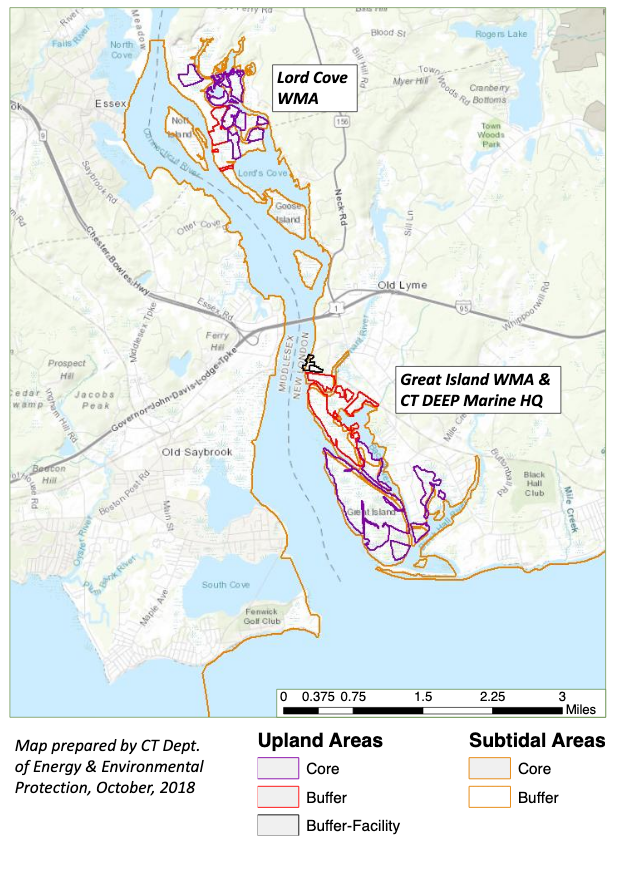
Proposed CT National Estuarine Research Reserve (NERR) site map- Western areas.
For me, working on Connecticut’s NERR site selection and designation teams has been both a labor of love and an extremely rewarding experience in building my knowledge of the Connecticut River and the organizations and people that call it home.
One day I was talking with Dick Shriver, whom I had met at MCCD and partnered with to deliver enrichment sessions to classes at the Bennie Dover Jackson Middle School in New London. We were discussing the large number of organizations and interests that exist along the entire length of the Connecticut River—soon to be joined by the CT NERR. The idea of a magazine, to be a focusing voice and vehicle of collaboration among these various interests, suddenly struck us. Finding nothing extant that would meet our concept for such a voice, we initiated the planning and designing of Estuary magazine together with a business and marketing strategy.
The first issue demonstrated that our team of talented writers, editors, photographers, graphic designers, and media and printing professionals can produce a high-quality product that is a credit to the beauty of the River and its watershed. I believe that where we go from here, as I hope that I have illustrated in my story, will depend considerably on the depth of the emotional commitment and affection—love—that our readers either have or will develop for the River.
My Connecticut River
For this inaugural blog, I thought that I would recount several of my Connecticut River experiences that fostered the strong emotional attachment that I hold for the River today. They happen to intersect five of the articles that either appeared in the first issue or are planned to appear in one or more of the next three quarterly issues of the magazine. Why start here? Because a wise consulting practice called Vital Smarts once wrote persuasively,
“Finding a way to encourage others to both understand and believe in a new point of view may not be enough to propel them into action…. At some point, if emotions don’t kick in, people don’t act.”
Patterson et al., Influencer: The Power to Change Anything
Growing up as a Boy Scout in a small town outside of Boston, my first encounter with the Connecticut River was a 45-mile, downriver canoe trip that started with overnight camping near the Dartmouth Outing Club in Hanover, NH. (An article in the upcoming Summer 2020 issue of Estuary magazine on page 7 describes the 1773 journey of John Ledyard in a dug-out canoe over part of the same route.) The next day, under clear skies with no incidents, we neared the half-way point and stopped on the Vermont side to scramble up a bridge embankment to restock our supplies at a general store. That night, we pitched our tents and camped out in a dairy farmer’s field that bordered the river on the New Hampshire side. The next morning, we awoke to several curious cows rummaging through our campsite; we were anxious that they would crush our tents, but our fears were unfounded. The rest of the trip through bucolic landscapes proceeded uneventfully, and we hauled out in the vicinity of the Bellows Falls Dam. For a 13-year-old boy, this was the trip of his young life.
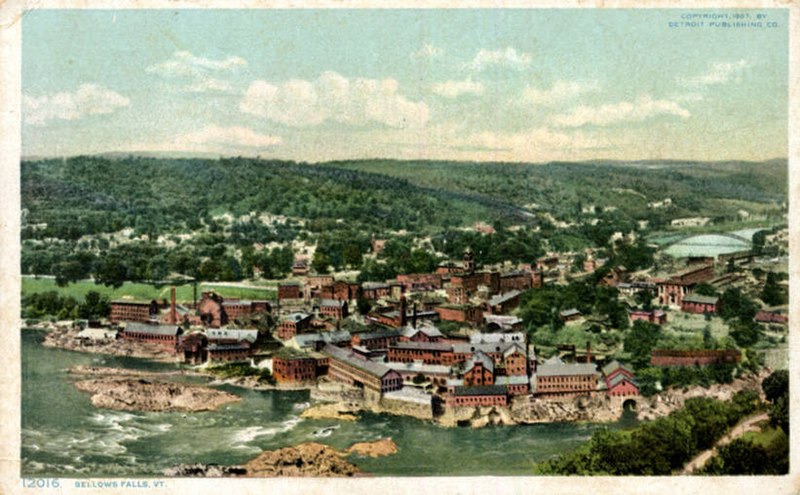
Bellows Falls, Vermont
I did not return to the Connecticut again until after I was married and in graduate school. This time, about a week before Thanksgiving, I went deer hunting with my father-in-law in the thick woods surrounding the Connecticut Lakes in far northern New Hampshire—the very source of the Connecticut River. The weather was bitterly cold and the snow was waist high, which made walking any distance exceedingly difficult, even with snowshoes. We came home empty-handed but had enjoyed the company of our back-woods host, a habitual punster (likely his defense against cabin fever), and his wife, who gave me my first taste of deer-heart stew for dinner one evening in their kitchen that was overheated by a glowing wood stove.
Years later, toward the end of winter, I came back to this region to attend my niece’s wedding at the nearby Balsams Grand Hotel and Resort, which has many recreational amenities, including hiking, mountain biking, and cross-country skiing trails. The Balsams, by the way, houses in its bowels a small, wood-paneled room that was the earliest polling place to open for presidential elections in the United States. At that time, as I recall, the diminutive town of Dixville Notch, NH, had a turnout of around 12 voters at midnight at this polling location.
Many more years passed before I got back to the Connecticut River. During this time, we raised our family in upper New York State, moved for a period to West Virginia, and then moved back to New England, where we settled in Glastonbury, CT, which has a serpentine border on its west side with the Connecticut River. It was at the ferry landing in Rocky Hill, just across the river from Glastonbury, that I purchased my first “pair” of fresh roe from a river-caught shad. I was subsequently taught by a long-time resident how to cook this delicacy. As fate would have it, sometime later I returned the favor by cooking shad roe for this friend just a couple of days before he died. His last words to me, “Don’t boil the water,” will forever remain in my memory as an indelible part of his no-frills recipe: poach the roe in simmering water for about 20 minutes; then carefully transfer to a well-buttered skillet, heated to medium temperature, and fry until golden brown. Handle the roe lobes very gently so as not to break them at any step. (For a fancier recipe, see the article “What’s for Dinner?” on p. 69 of Estuary magazine, Spring 2020.)
While living in New York State and then in West Virginia, I took up bicycling with a passion. This time I was able to afford decent road bikes, as opposed to the junkers that I rode, also passionately, as a kid. To my delight, I was pleased to find from my base in Glastonbury a multitude of exhilarating riding routes that thread through the River’s watershed, track along the River’s shores, and sometimes cross it. These routes span south to the mouth of the river at Long Island Sound and north to Westfield, MA. Most feature gorgeous scenery along the river and its tributaries; crossings are via bridges (Baldwin, East Hampton, Arrigoni, Founders, Veterans) or ferry (Glastonbury-Rocky Hill, Chester-Hadlyme).
One of my favorite northern rides, organized by River’s Edge Cycling in Sunderland, MA, is a 100-mile round trip that starts in Northampton, MA, and follows the west side of the River to Brattleboro, VT, after passing through the historic Massachusetts towns of Deerfield and Turners Falls.
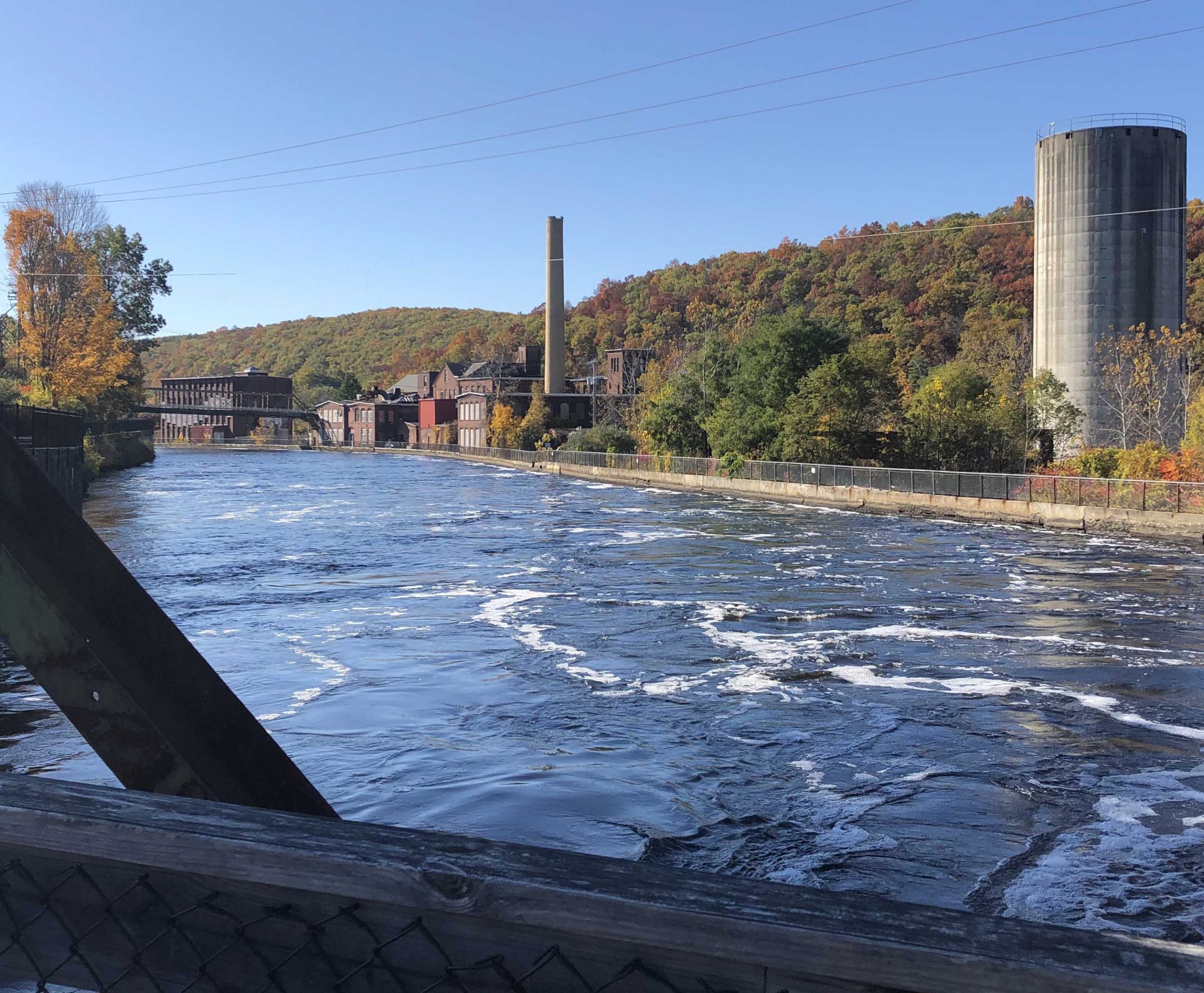
Turners Falls, Massachusetts
The route then crosses into New Hampshire the next day and follows the east side of the River back to Northampton. (Forthcoming is the article “Cycling the Valley” on page 13 of Estuary magazine, Summer 2020.)
In addition to taking in the beautiful scenery on these rides, we manage to find outstanding restaurants for lunch. One particularly cherished ride that traverses the hilly terrain of the watershed between Marlborough and Chester, CT, has the name “Pie Ride” in recognition of the huge (18-lb) apple pie that chef-owner Dennis Welch bakes for us at his restaurant, The Wheat Market. One 1 ½ lb slice of this pie is enough for breakfast, lunch, and dinner combined; the trick is to bicycle up the hills on the 20-mile return trip without “losing” the pie.
In case you haven’t guessed already, bicycling and sharing meals with a group of friends in the exquisite surroundings of the Connecticut River renews my soul and has added considerably to my emotional bond with the River.
I will conclude my story in the next blog.
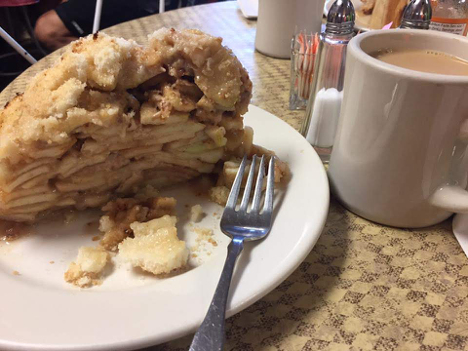
A 1 1/2 lb. piece of pie waiting to be eaten.